New movement software allows for notation practices in which the focus is on the multiple potentialities of movement that a body holds. This allows for a move away from a static representation of forms and ideas towards an ‘art of potentiality’. In this context, the computer becomes an important element for choreographers, not as an imaging device but as a medium in a process of emergence. Easy to use technologies like digital cameras and weblogs are widely used, not only to capture and disseminate finished works, but also to document and share creation processes, as mediators in new modes of (self) reflection about these processes, as a means to mediate in future processes of understanding the work, and even to anticipate its future historicity.
This ignored gestural quality of speech gains new importance now that contemporary body / machine interfaces increasingly include haptic and tactile modalities. These new developments allow for new modes of embodied interaction between body and machine and these new modes of interaction make possible alternative modes of handling information and knowledge, of navigating through information by means of gesture. More radical than that, new information technologies hold the potential of gesture to become part of communication at a more fundamental level, and necessitate a reconsideration of the impact of alphabetic writing and print as a medium. These new technologies make possible a shift from communication through writing towards movement (actual or imagined) as a means of comprehension.
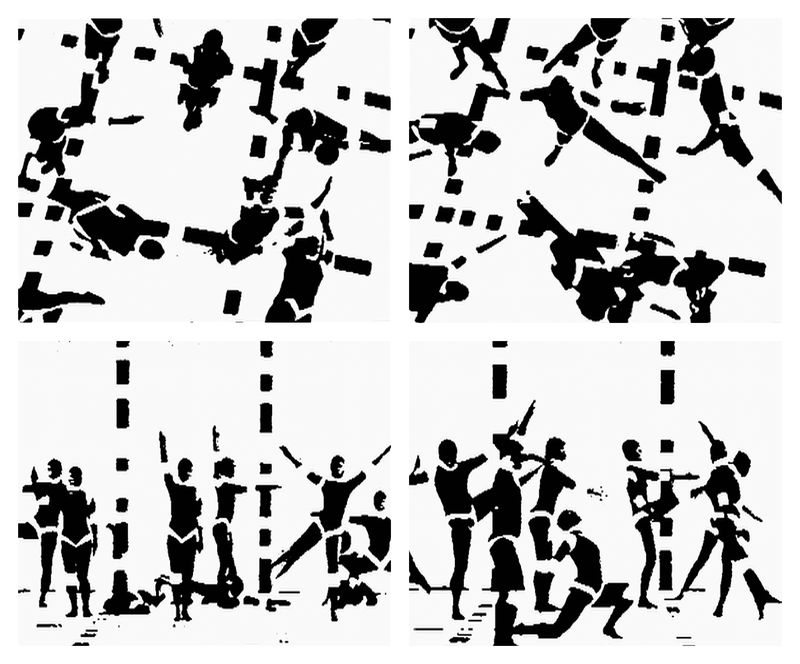
Carrying on this significant legacy into video-dance, and ahead of its time, Cordeiro's M3x3 represents an embodied posthumanism. With its intersection of dance and camera, and dance and computer, the body in M3x3 is definitively a hybrid body, a mediated body, a machine body, while also a human body. She chose to work with human dancers rather than create an animation.
Hence, the video proposes the effects of technology on the body in consistently layered ways: 1. Most literally, television is the medium through which we perceive these mediated bodies, so the bodies exist only as a result of the medium by which we view them. 2. The bodies' movements are the outcome of computer programming, instruction, and information. 3. The movements themselves, "broken in (their) quick and stiff gestures," mimic the rigidity and stutter of the machine (Machado 2016, p. 88). 4. Lastly, the black and white costumes and gridded stage simulate the black and white of the camera and television monitor.
To begin the research for the programming of the Nota-Anna software, the movements of the body were represented in an abbreviated way as polygons. From a mathematical point of view, each movement of the body was symbolized by a polygon of two or three dimensions, depending on the movement. This sketch schematizes the variable relationship of the polygons, as Cordeiro notes in the sketch:
“The variations the polygons undergo are in regard to 1. dimension and/or relationship of their Cartesian axes, symmetry. Centered on the dancer's navel. Front (left side).”
The drawing delineates the relationships of arm, leg, torso and head.
Giannetti, Claudia, ed. Analívia Cordeiro: From Body to Code. Munich: Hirmer Verlag, 2023. ISBN 978-3-7774-4193-1.
More than to the choreographic creation, however, the computer notation would be important for preserving cultural heritage, in process of being forgotten and then lost, like a traditional dance of Yemen. The film of this dance was entrusted to Analivia. Computer notation should be enhanced with mathematical precision to record the filigree of fine, discrete, and subtle movement. This allows a combination of computer image processing, essentially analytical, and what might be called synthetic media (although, paradoxically, partial) of movement fixation, as in film and videotape.
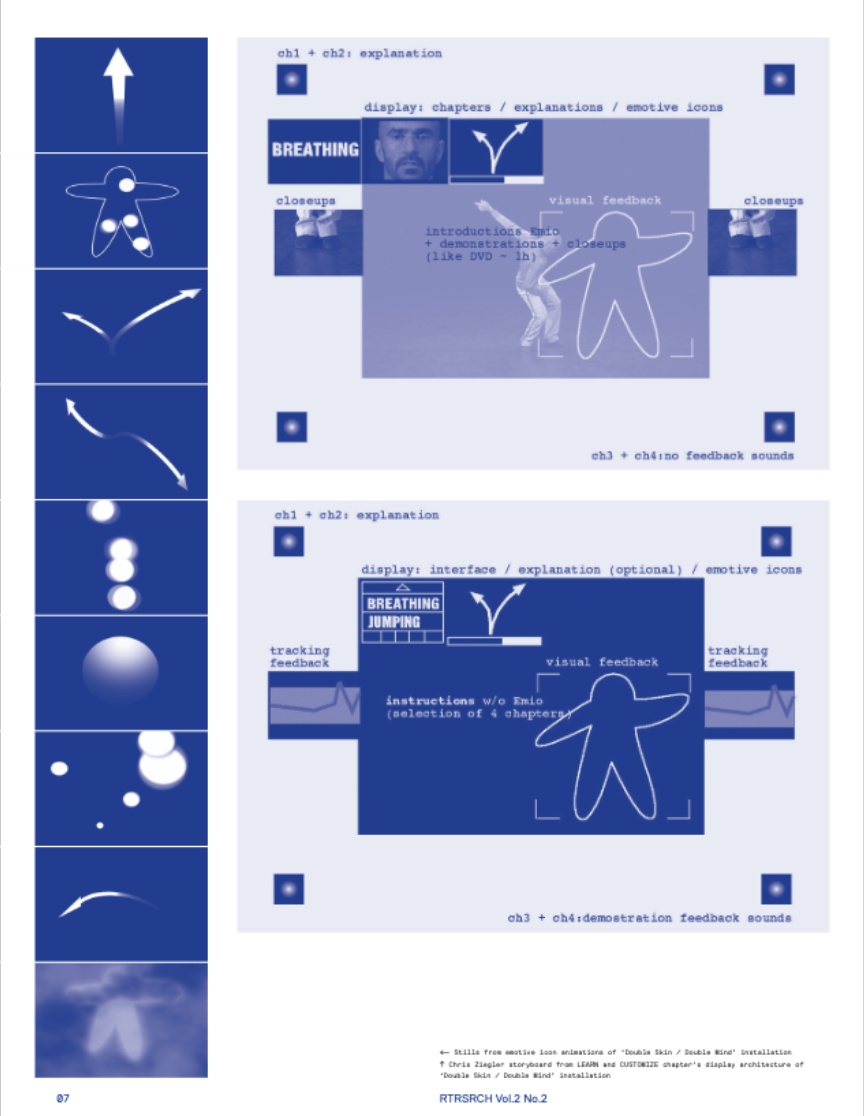
The development of the interactive installation Double Skin/Double Mind departs from the research questions the interdisciplinary research project (Capturing) Intention was based on: What is it exactly that we do in our attempts at capturing dance? How do we deal with its ephemeral nature? Which are the existing systems for its documentation? How do these systems deal with qualities and intentions? And even more importantly: which disciplines can help us understand the knowledge that is dance? [1]
With the workshop's specific qualities, intentions and modes of transmission providing the departure point for the installation development, the need to question and adapt all involved elements (software, tracking systems, design and interactive modes) became essential. To achieve an awareness of embodiment the installation had to focus particularly on the question: how can motion capture, new media interface design and gesture analysis be used when looking at more qualitative elements than quantitative parameters?
[1] Dedication from (Capturing Intention), Documentation, analysis and notation research based on the work of Emio Greco | PC © 2007, EG | PC and AHK ISBN: 978-90-810813-2-0